
We have all experienced those heavy, fog-filled mornings when our daily routine begins to feel entirely stale. You sit down at your desk in Shenzhen or open your laptop in Hangzhou, and the simple act of facing a straightforward work task feels like an uphill battle. For individuals who naturally navigate variable attention patterns—where the mind constantly resists immediate priorities in favor of falling down a rabbit hole of First Amendment audit videos when you’re supposed to be filling out spreadsheets—finding a reliable pocket of sustained, calm focus is a frequent pursuit.
Recently, an informal, individual $n=1$ experiment yielded some highly unexpected data. Instead of chasing a highly curated, aggressive “focus blend,” an individual altered their morning routine to address entirely separate, baseline health goals. On an empty stomach, they consumed a baseline cup of coffee, two optimized Acetyl-L-Carnitine (ALCAR) capsules, a standard 120mg dose of Ginkgo Biloba (intended purely to manage a persistent bout of tinnitus), and 25mg of micronized dehydroepiandrosterone (DHEA) for general hormonal support.
What followed was not a jittery, anxiety-inducing spike in nervous energy. Instead, this accidental combination unlocked a remarkably steady, six-hour window of uninterrupted, calm cognitive output.
Because this specific mix was never intended to alter mental performance, the placebo effect was naturally minimized. When the brain does not anticipate an outcome, it does not actively manufacture a false reality. This leaves us with a compelling biochemical puzzle: how did a handful of seemingly unrelated supplements accidentally lower the attentional friction baseline? To understand the underlying mechanics, we must examine how these specific compounds interface with our neural networks simultaneously.
Why Does This Combination Trigger a “Synchronized Synapse”?
The sudden clarity experienced during this experiment is a classic demonstration of pharmacodynamic synergy. In neurobiology, true synergy occurs when the combined impact of multiple compounds is significantly greater than the sum of their individual parts.
Instead of relying on a single, high-dose stimulant to force executive function through sheer cellular exhaustion, this combination interacted with multiple distinct neural pathways simultaneously. By concurrently touching dopamine preservation, acetylcholine synthesis, cerebral microcirculation, and neurosteroid receptor modulation, the stack optimized the brain’s overall working environment. This multi-target approach created a stable state of task engagement without the sudden energetic crash associated with traditional central nervous system stimulants. However, a chemical combination is only as effective as its delivery window, which brings us to the precise physiological context of the ingestion.
How Does Metabolic Timing and an Empty Stomach Amplify the Effects?
The physiological context of this experiment was highly optimized. Taking this specific combination on an empty stomach acted as a significant accelerator for bioavailability—the rate and extent to which active molecules enter systemic circulation to cross the blood-brain barrier.
Without food or competing macronutrients in the gastrointestinal tract, these compounds were absorbed rapidly and cleanly. If they had been taken with a heavy breakfast, dietary amino acids from proteins would have competed with the Acetyl-L-Carnitine for transport carriers across the intestinal wall, while fats and complex carbohydrates would have delayed gastric emptying, spacing out the absorption of the caffeine and Ginkgo.
By entering a clean metabolic environment in unison, the compounds reached peak plasma concentration in the bloodstream at the exact same time, overlapping perfectly at the level of the cerebral architecture.
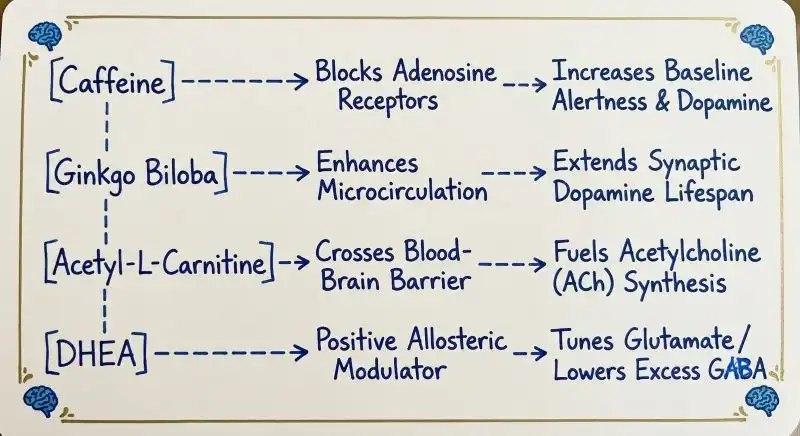
What Neural Pathways Are Driving This Extended Window of Focus?
When we strip away the commercial supplement labels, the underlying biochemistry reveals a highly coordinated interaction within the central nervous system, where each component effectively addresses a functional bottleneck for the other.
- Caffeine as the Primary Engine: Caffeine acts as an adenosine receptor antagonist. By blocking adenosine—the molecule responsible for signaling sleepiness and accumulating daily mental fatigue—it raises baseline wakefulness. Crucially, this blockade prompts a natural release of dopamine in the striatum, providing the foundational neural motivation to engage with a task.
- Ginkgo Biloba as Circulatory and Enzymatic Support: Standardized Ginkgo Biloba assists the caffeine engine beautifully. First, it supports the dilation of microvessels, improving cerebral microcirculation and ensuring the cortex receives a steady supply of oxygen and glucose. Second, research suggests Ginkgo acts as a mild, reversible inhibitor of monoamine oxidase (MAO), the enzyme tasked with breaking down catecholamines. By slowing this breakdown, the dopamine mobilized by the morning coffee remains active within the synaptic cleft for a sustainable duration.
- Acetyl L-Carnitine (ALCAR) as the Focus Stabilizer: While dopamine provides the drive to initiate a task, acetylcholine (ACh) is the primary neurotransmitter responsible for maintaining concentration and filtering out peripheral distractions. ALCAR efficiently crosses the blood-brain barrier, where it donates its acetyl group to form Acetyl-Coenzyme A—a critical building block for acetylcholine synthesis. By bolstering the cholinergic system, ALCAR provides the computational resource necessary for the brain to minimize attentional drift.
- DHEA as the Neurosteroid Modulator: Though recognized as a systemic hormone precursor, DHEA ($C_{19}H_{28}O_{2}$) is also an active neurosteroid synthesized within the brain. It functions as a positive allosteric modulator of the excitatory NMDA glutamate receptor and a negative modifier of the inhibitory $GABA_A$ receptor. By subtly tuning up the glutamate pathways responsible for processing information and dialing down excess inhibitory signals, DHEA increases cortical alertness, making the brain feel highly receptive to complex problem-solving.
How Does This Complex Chemical Dance Translate to Everyday Productivity?
To visualize how these microscopic mechanisms manifest in daily life, it helps to map this entire system onto a familiar real-world scenario: a complex manufacturing assembly line. When executive function fluctuates, it is usually because the workforce is sluggish, supply lines are delayed, or the machinery lacks direct power.
In this scenario, the coffee acts as the morning shift whistle, waking up the workforce and giving them the initial drive to head to their stations. The Ginkgo Biloba clears the logistical traffic outside the factory, opening up the roads so delivery trucks can drop off fresh fuel, while ensuring the workers do not pack up their tools too early in the day.
Meanwhile, the Acetyl L-Carnitine delivers premium, specialized electricity directly to the most intricate machinery on the floor, allowing the factory to execute high-precision operations without stalling. Finally, the DHEA behaves like an efficient operations manager, optimizing the workplace tempo, smoothing out communication bottlenecks (glutamate), and minimizing unnecessary downtime (GABA).When all four conditions are met simultaneously, the assembly line functions flawlessly, and the mental friction that typically derails a morning simply vanishes. Yet, running any biological facility at maximum capacity inevitably introduces the question of long-term sustainability.
When Does Cognitive Optimization Turn Into a Homeostatic Risk?
While a six-hour window of effortless productivity is an encouraging outcome, a healthy dose of scientific caution is necessary before assuming this protocol can be repeated indefinitely. This observation represents an $n=1$ data point—an isolated experience on a single individual over a single day.
The human brain is governed by homeostasis, a constant striving for internal balance. If these pathways are continuously stimulated with the exact same stack every single morning, the brain will eventually adapt to protect itself. This can result in the downregulation of natural receptors, meaning the stack might eventually be required just to achieve a baseline level of focus, while those deep, steady flow states begin to diminish.
Furthermore, introducing exogenous compounds like DHEA introduces notable systemic variables. Depending on an individual’s unique baseline biochemistry, age, and biological sex, DHEA metabolizes along highly individualized pathways, meaning chronic use requires careful structural consideration and monitoring. Similarly, natural genetic variances—such as differences in the enzymes that clear dopamine or acetylcholine—mean that a supplement combination providing perfect clarity for one person might cause mild anxiety, headaches, or restlessness in another.
Ultimately, this accidental experiment provides a fascinating look into the interconnected nature of our biology. It demonstrates that cognitive performance is rarely about pulling a single chemical lever; rather, it is about harmonizing an entire internal ecosystem. Finding a sustainable path to cognitive clarity is a journey of careful, individualized exploration rather than a permanent shortcut. To discover the core engineering and frameworks that power this type of systemic mental optimization, explore the ecosystem at sapientro.com
Scientific References
- Caffeine & Adenosine: Fredholm, B. B., et al. (1999). Actions of Caffeine in the Brain with Special Reference to Factors Involved in Its Stimulant Effects. Pharmacological Reviews. [Link to Study]
- Ginkgo Biloba & MAO Inhibition: Slowing, K., et al. (2009). Evaluation of Ginkgo biloba extract as an inhibitor of monoamine oxidases. Journal of Ethnopharmacology. [Link to Study]
- Acetyl-L-Carnitine & Acetylcholine: Traini, E., et al. (2011). Effect of L-carnitine and derivatives on cholinergic neurotransmission. Mechanisms of Ageing and Development. [Link to Study]
- DHEA as a Neurosteroid: Compagnone, N. A., & Mellon, S. H. (2000). Neurosteroids: Biosynthesis and Function of These Novel Neuromodulators. Frontiers in Neuroendocrinology. [Link to Study]